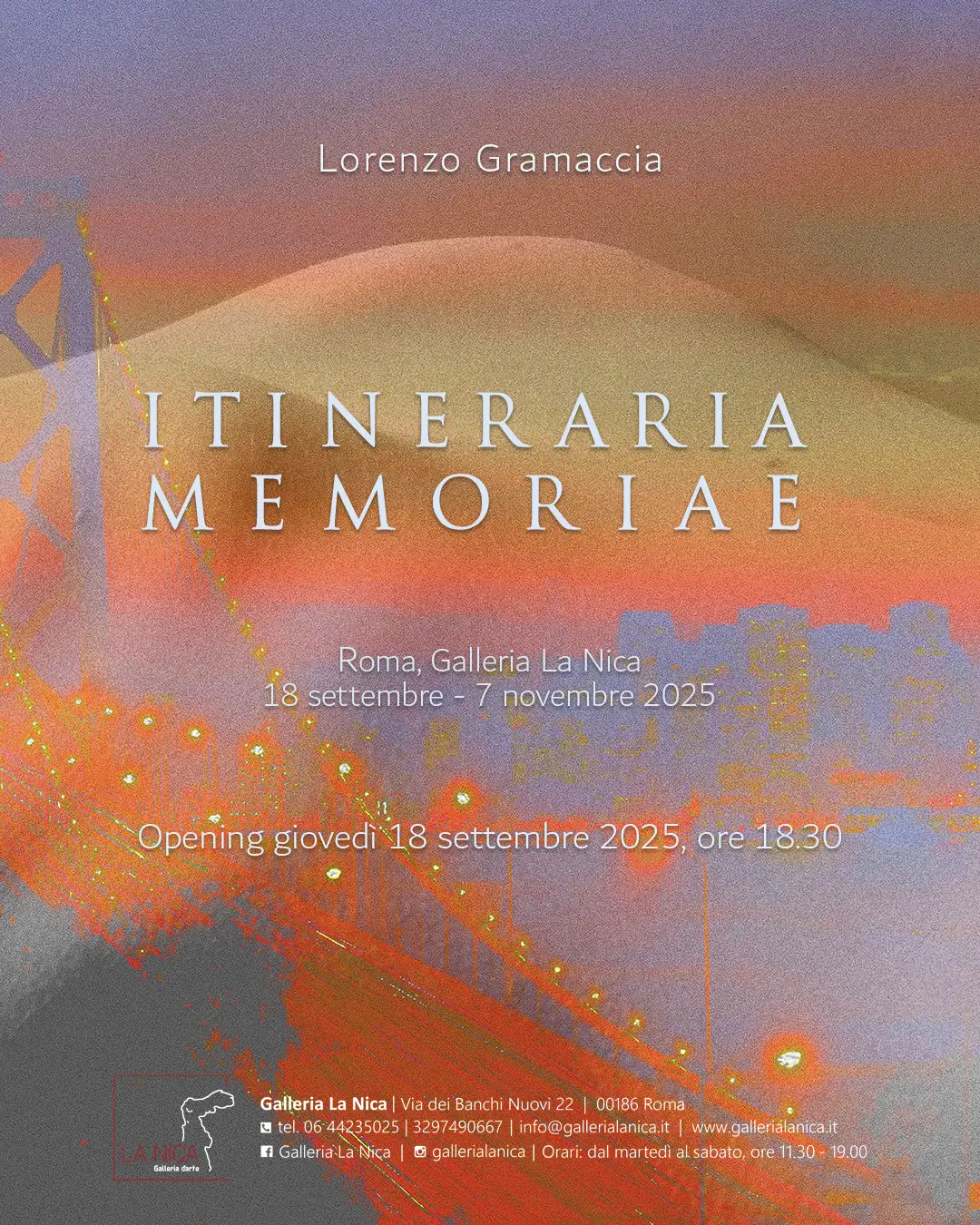
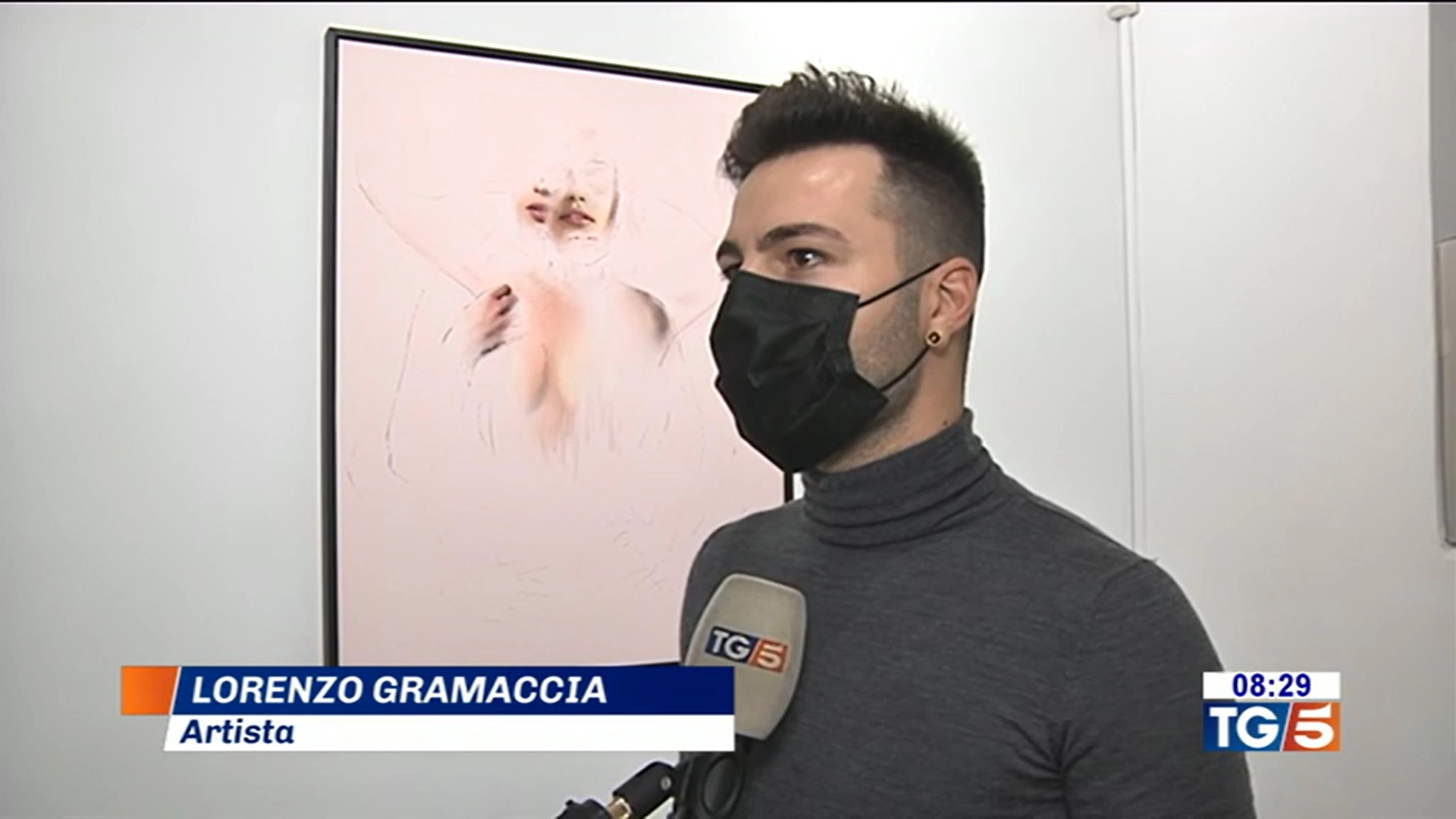
Itineraria Memoriae
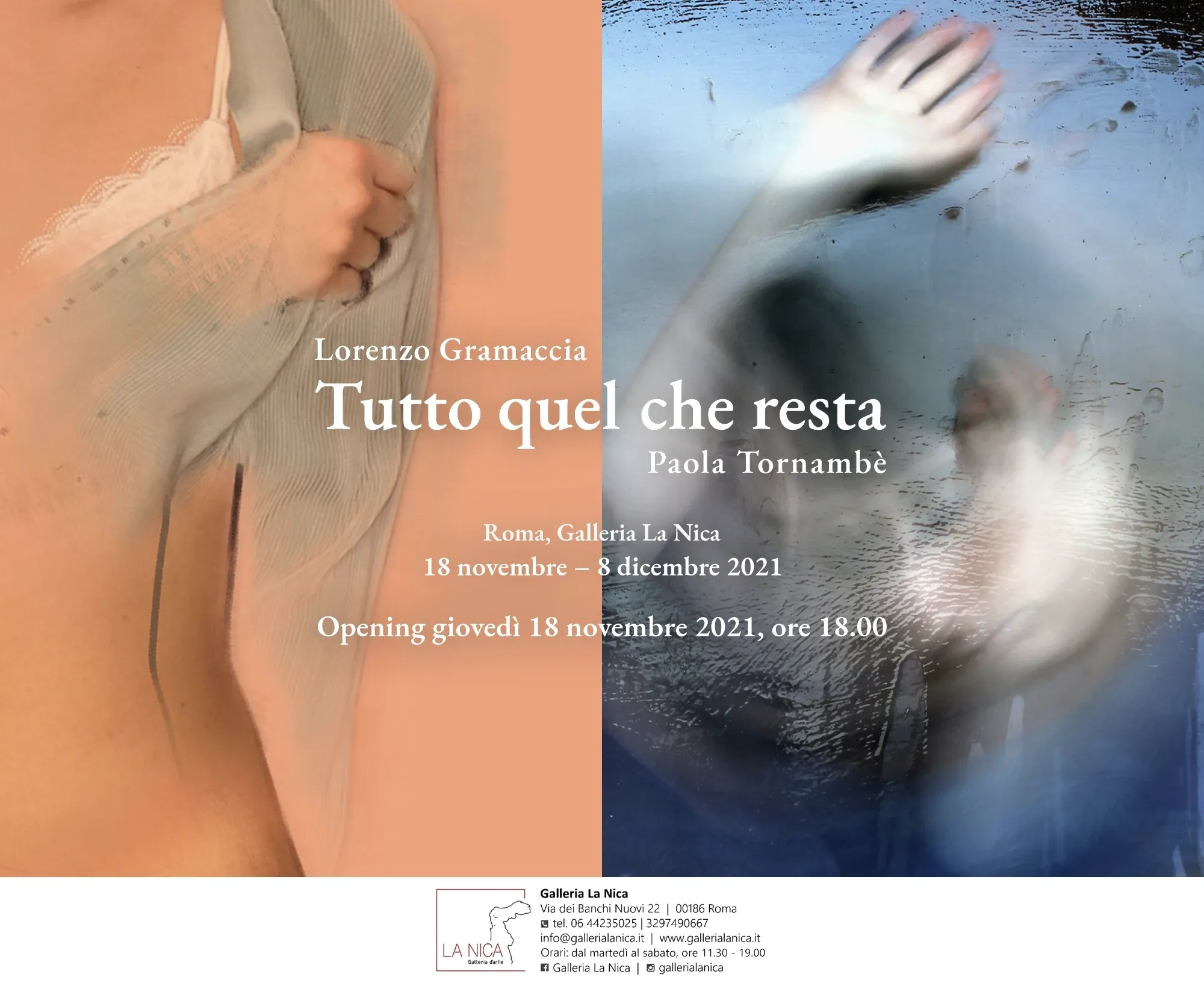
September 18–November 7, 2025
Galleria La Nica, Rome
Critical text by Maria Vittoria Marchetta
“Every visited place leaves an imprint. Every body retains
invisible traces of what it has traversed.”
Every space we cross changes us. Sometimes we perceive it
immediately, other times we discover it later, in a familiar scent,
in a returning light, in a blurred sound. Places traverse us just as
much as we traverse them, imprinting themselves on the skin, in the gaze,
in the posture we assume before the world.
The body preserves everything; it does not forget what the mind sometimes
seems to let go, silently guarding lived emotions, encountered landscapes,
and dormant impressions. It is a sensitive, stratified, mutable archive.
Every fold contains something that has passed yet still dwells within.
Thus we walk, carrying with us places we no longer see, but which have
become part of our way of feeling. Every body is a map, and every map
an intertwining of memories pulsing beneath the skin and within the mind.
Always interested in the dichotomy between man and nature, as well as
in the fragility and transitoriness of human existence, Lorenzo Gramaccia
(Ancona, 1992) seems, in his new cycle of works, to reflect precisely on
the idea that memory is not merely a mental construct, but an experience
inscribed in places and deposited within bodies.
Itineraria Memoriae stems from this awareness and unfolds
as a visual and sensitive journey where landscape and body overlap,
intertwine, and dissolve into a narrative that speaks of collective memory
as much as of intimacy.
The title recalls an ancient suggestion: the Roman Itineraria,
those registers of routes and distances that guided travelers through
the cities and roads of the Empire. They were orientation tools, but
also registers of movement and of the relationship between body and space.
Like the travelers of the Grand Tour, who crossed Europe
in search of wonder and knowledge, annotating impressions, views, encounters,
and moods in their diaries, Gramaccia too gathers the traces of his
own experiences during his many travels. Yet, once he returns home, within
the intimacy of remembering, he does not merely narrate to elaborate his works;
he overlaps, he does not describe, he evokes.
The results are visual diaries in which the traversed landscapes merge
with the body that has lived them. The artist thus reclaims the idea
of the itinerary, but the goal is not to propose a cartography of reality,
rather to offer us a journey through the maps of memory, in places
lived not only physically but also internally and emotionally; paths
that are not measured in miles but in deeply intimate sensory and visual layers.
And if the young grand tourists of the past transformed experience
into narrative, Gramaccia transforms memory into vision.
As Walter Benjamin wrote: “What matters, for the author who remembers,
is not what he has experienced, but the weaving of his memory, the Penelope
work of remembrance. Or should one rather call it the Penelope work of forgetting?”
In this sense, Gramaccia’s work is not documentation, but sedimentation:
a weaving of presences and absences that suddenly emerge and disappear,
and which, like warp and weft, intertwine until they become an image.
The works never offer an unambiguous vision; in them, memory is fragmented.
Urban and natural landscapes, city glimpses, reliefs, dense skies, and suspended
architectures merge with bodily traces surfacing like apparitions. In this
encounter, the body becomes territory and the landscape becomes flesh.
This aesthetic of superimposition also has a precise technical root.
Following his academic training in Painting at the Academy of Fine Arts
in Rome, Gramaccia chose in 2020 to open up to the digital universe,
exploring new languages through digital painting and layering software.
His practice does not betray painting, but transfers its essence into a
language made of glazes and transparencies. Digital layering thus
becomes not only a compositional tool, but a metaphor for memory: every layer
is a trace, a deposit of time and sensations.
The images, in their continuous making and unmaking, narrate the instability
of memory, the fragility of identity, and the tension between permanence
and transitoriness.
In this latest cycle of works, Lorenzo Gramaccia also explores the hybridization
of the body with the environment and technology, reflecting the profound
transformation sweeping through our time. This transformation is grafted
onto a widespread crisis:
“New generations often seem to me bereft of the certainties of the past—faith, a stable job, a solid family—and find themselves
suspended in an uncertain present. Added to this is the loneliness, amplified
by social media. It is a fragile, fragmented inner landscape, full of restlessness.
Yet, in my works, the body merging with the landscape is not only a wound
or a fracture: it is also a possibility for reconciliation. I believe that nature
guards a different, more human time, which can oppose the continuous acceleration
and digital hyperconnection. The landscape, fused with the body, thus becomes a map
of contemporary crises, but simultaneously a space of harmony, a place to rediscover
a slower, authentic, necessary breath.”
Lorenzo Gramaccia wishes to suggest that memory is a dynamic space and that
the journey must be understood not only as a physical movement towards a destination,
but above all as an inner crossing.
As in the ancient Itineraria, in Gramaccia’s works one moves from
one point to another, but here distances do not matter, nor are coordinates
needed. One simply needs to let oneself be traversed.
Critical text by Pietro Roccasecca
Lorenzo Gramaccia exhibits a series of digital paintings:
graphic and pictorial elaborations of printed photographs, on high-quality
Hahnemühle paper, finished with subtle manual graphic interventions.
Lorenzo is classical by training and natural inclination, yet not detached
from his time: he trained as an artist at the Academy of Fine Arts in Rome,
attended the School of Painting, and distinguished himself for his drawing;
he won prizes and competitions for his graphic and pictorial talent. He draws
in graphite and experiments with ancient techniques such as metalpoint: the Vatican
Museums preserve some of his drawings. However, his aptitude for research and his
desire to experiment, leaving no path unexplored, push Lorenzo to confront digital
drawing and photography.
The works on display represent the current state of his graphic research and,
knowing him, we intuit that it is merely a stage in his investigation into the
territory of visual art. Nevertheless, the choice to focus on photography and digital
painting, reducing analog drawing to finishing touches, was a turning point:
criticized by traditionalists who raise an eyebrow at the abandonment of the
analog and the loss of the aura of the artist’s hand, and by proponents of new
technologies who turn up their noses at the controlled and intimately drawn composition
of the work.
These criticisms are superficial and inessential: techniques have changed many times,
and the introduction of digital drawing is comparable to that of paper centuries ago.
None of the great artists of the time stubbornly clung to parchment, and all experimented
with the new media available to them. Our contemporaries do the same with the digital;
the functions of digital applications reproduce the technical steps of analog drawing,
saving time. The quality of a work of art is not measured by the exertion required to execute it.
Analog or digital, Lorenzo’s graphic and compositional process does not change;
it always occurs through layering. If anything is lost in the transition from analog
to digital, it is erasure, which, as William Kentridge teaches us, fully belongs to drawing.
Gramaccia’s work is characterized by the study of the human body, which is almost a
taboo in contemporary art: drawing a human body from life labels you an academic
traditionalist, period. However, contemporary art has several strands of approach
to the body, for example, my favorites: James G. Ballard, who in the 1970s explored the
interpenetration of the body with machines in The Atrocity Exhibition and later
in Crash; or the understandable rebellion of the New Body Art against
the commodified use of the female body that our patriarchal society justifies and permits.
Or again, the surgical mutations of Orlan.
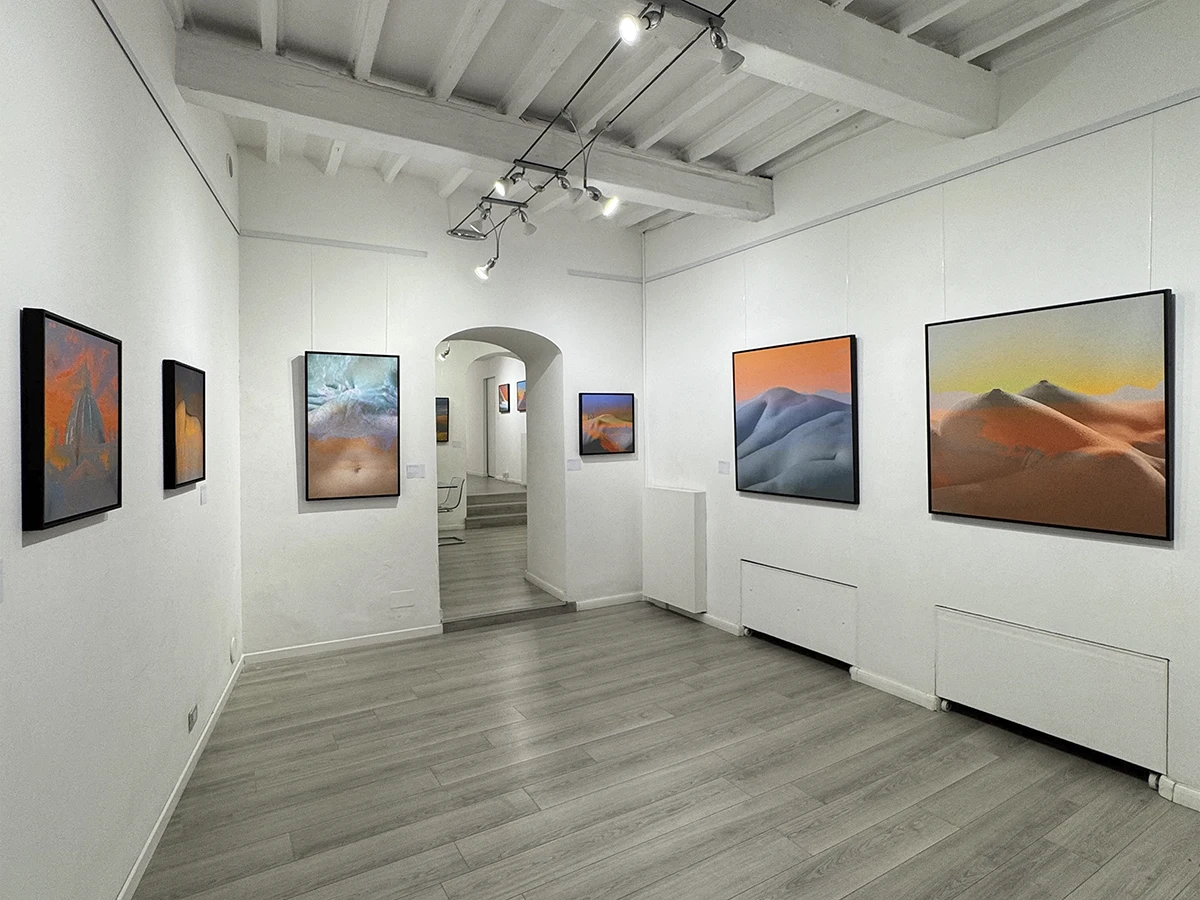
In this exhibition, Lorenzo investigates the human body in parts; it is certainly a matter of
metonymy: a part for the whole. But I also glimpse a lesson from Ciceronian rhetoric: no human
body intrinsically possesses all beautiful limbs, but it can be endowed with a portion of beauty.
In search of perfection, Zeuxis chose the five most beautiful maidens of Croton, selecting
individual limbs to reassemble into a portrait of Helen. Lorenzo is our contemporary and does
not reassemble limbs in search of a beauty that not even nature can afford to achieve and only
art can conquer.
In the works presented, the human limbs remain fragmentary and not always recognizable
at first glance; they are almost enigmatic forms associated with natural and anthropized landscapes.
Gramaccia does not seek beauty but investigates the memory of emblematic places on the planet
he has visited. “Gramaccia in his many travels gathers the traces of his own experiences,”
writes the exhibition’s curator Maria Vittoria Marchetta, “but once he returns home, within
the intimacy of remembering, he does not merely narrate; he overlaps, he does not describe, he evokes.”
The dominant color palette of the works is composed of the almost complementary pairing of
warm ochre and dense, luminous blue, which Lorenzo adopted upon returning from a trip to the
Wadi Rum desert. He often uses them inverted: the skies are ochre and the landscapes blue,
transforming human fragments into lunar scenarios and emblematic landscapes into evanescent
vibrations of color-light.
The colors of the desert dress the human forms, accentuating the comparison, the parallel,
between human limbs and the orographies of natural landscapes and metropolitan skylines
that stratify within the image. The painting becomes a locus of memory, as in ancient and
Renaissance mnemonics where memories were associated with loci in an imaginary palace.
In Lorenzo’s works, places and bodies are associated through juxtaposition and the similarity
of the morphological values of the forms; bodies summon places to memory, and vice versa.
“I had the majesty of Morro Dois Irmãos before me, but my mind was drawing you,”
writes Gramaccia in a brief lyric accompanying the work Saudade, thus revealing
the inventive process behind the works on display.
For Lorenzo, drawing is a mental activity, not (solely) a manual operation: drawing is thought,
it is logos, it is poetic discourse. To draw, photograph, and compose into evocative layers
what one has before the mind’s eye does not reproduce the visible. It is a poetic act that speaks
the language of dreams and activates non-verbal thought in the beholder.
Selected Press